A route through a landscape, not every property
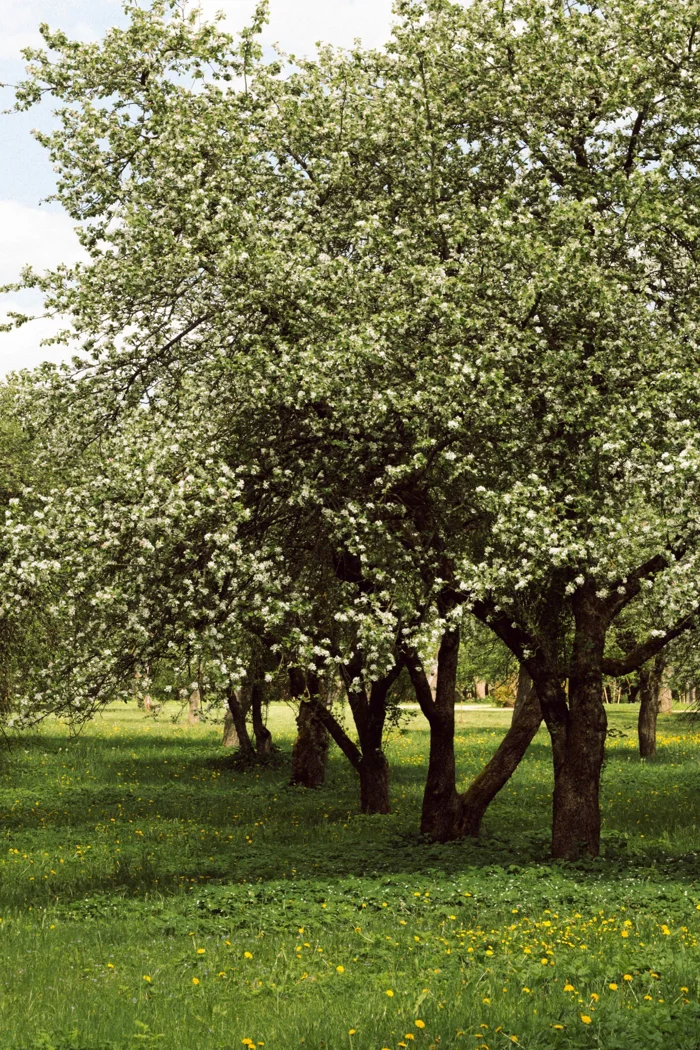
Widely spaced fruit trees can look open and inviting. That does not establish general access across every meadow. Choose a designated route and read local information. A public path through an orchard landscape differs from free use of the adjacent ground.
NABU describes orchard meadows as fruit-growing landscapes often containing high-stemmed trees of different varieties, while supporting many species. This combination provides interest for a walk: fruit production and other roles share the same trees and meadow. Entering the whole area is unnecessary to notice that arrangement.
For a first visit, select a short, clearly followed path. A local interpretation trail or published small circuit may help, but still check current access. A bench in a photograph does not establish that every approach to it is publicly available.
Focus on a few differences
Compare tree forms: broad crowns, narrow silhouettes, or branches beginning at different heights. There is no need to identify every variety immediately. Careful observation can remain with shape. If a board names varieties, establish which trees its labels describe.
Spacing and transitions matter too. Notice where the meadow begins, where a hedge joins it, and how the path sits between them. These relationships can be observed from the intended route. The best position is not necessarily directly beneath the most interesting tree.
For photography, repeated forms can provide a small theme. Leave the path clear and use accessible positions. A view between two crowns or along the route often explains more about the landscape than an extreme close-up of one fruit.
Let the season provide a recurring question
Blossom and visible fruit create different visits. Avoid fixing expectations to a universal calendar date. Actual development depends on place and conditions. If a particular stage motivates the outing, seek current local information or remain open to what is present.
Notice maintenance and use too. Mowing, grazing animals, or tree work can change the walk. Keep clear of ongoing work, follow notices, and choose another suitable connection where the route is temporarily unavailable. A landscape theme does not remove that consideration.
Establish any permission to gather fruit through explicit local information or the responsible owner or manager. Visible fruit and an accessible path do not automatically permit harvesting. The outing can be complete without taking anything away.
Repeat a small section
Choose a recognisable tree or stretch as a reference for later visits. Observe changes from the same accessible position. Repetition then has a subject without requiring exploration of more ground.
For further detail, look for local walks or information from the managing organisation and check current dates. A self-guided short outing can begin with the relationship between trees, meadow, and path. That question remains available on an ordinary afternoon.