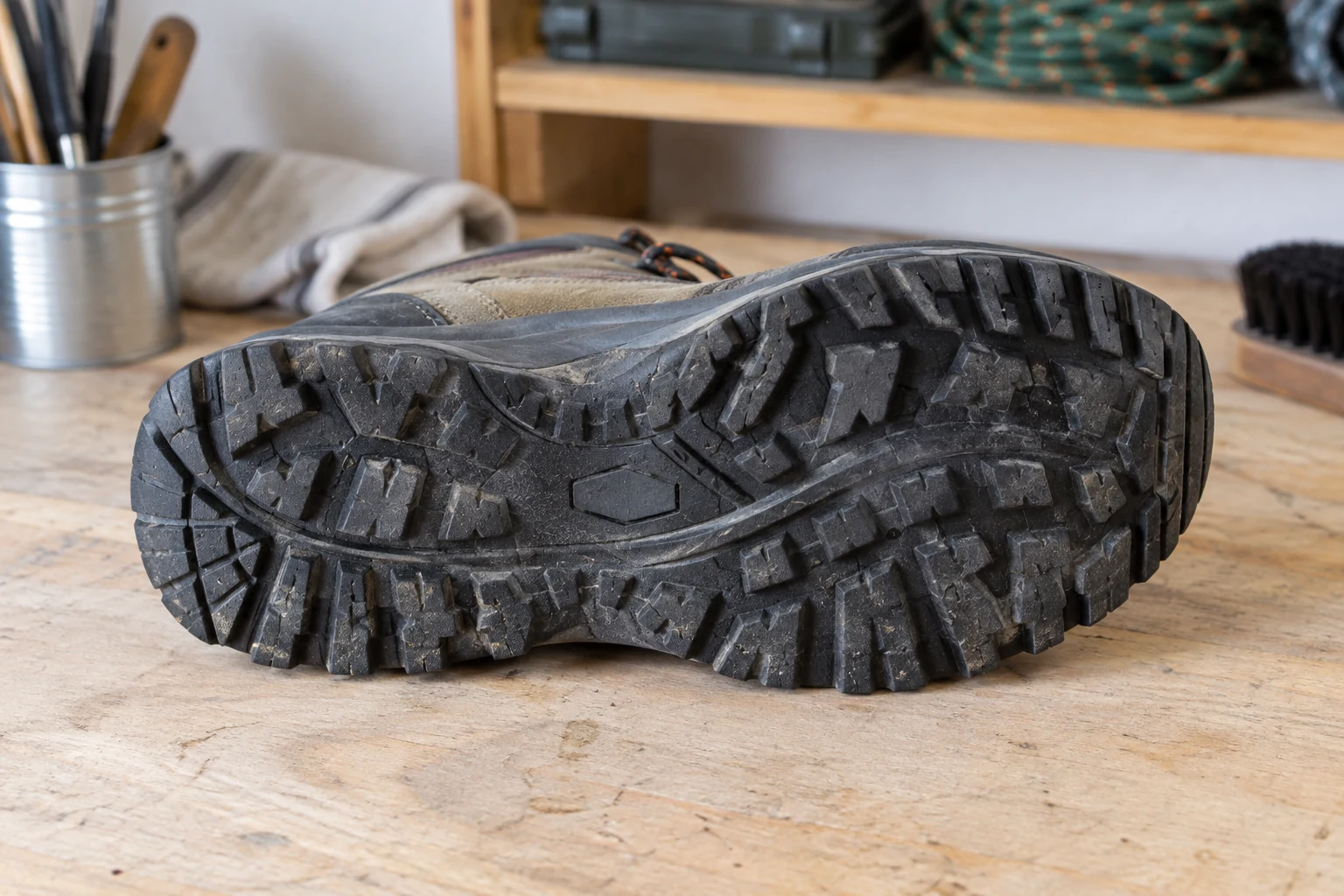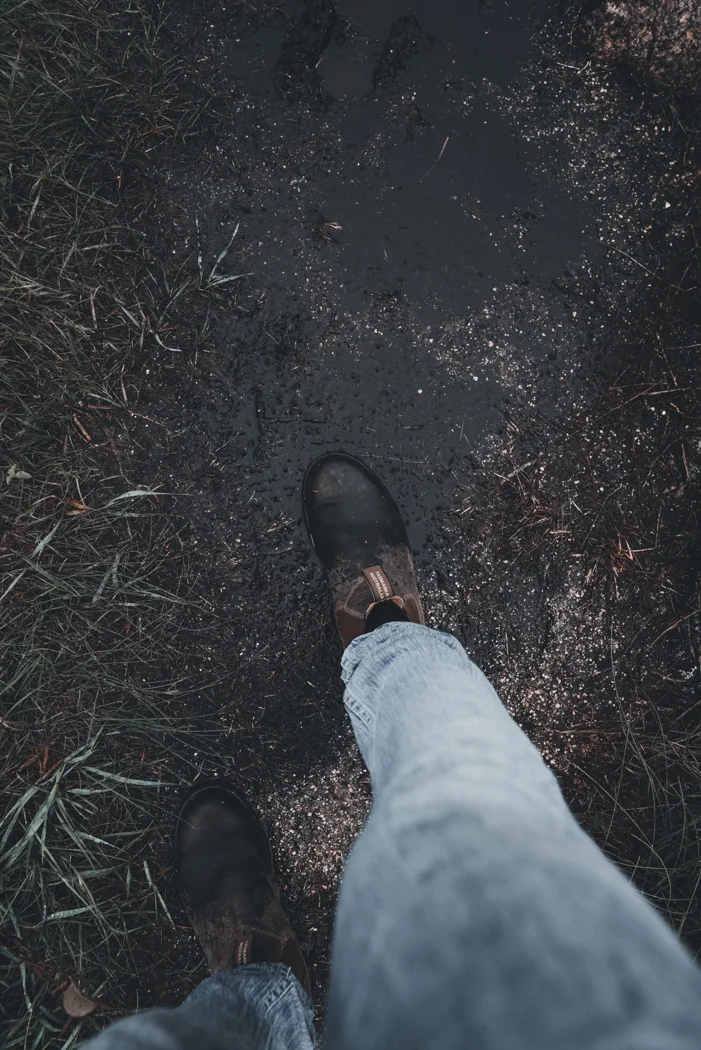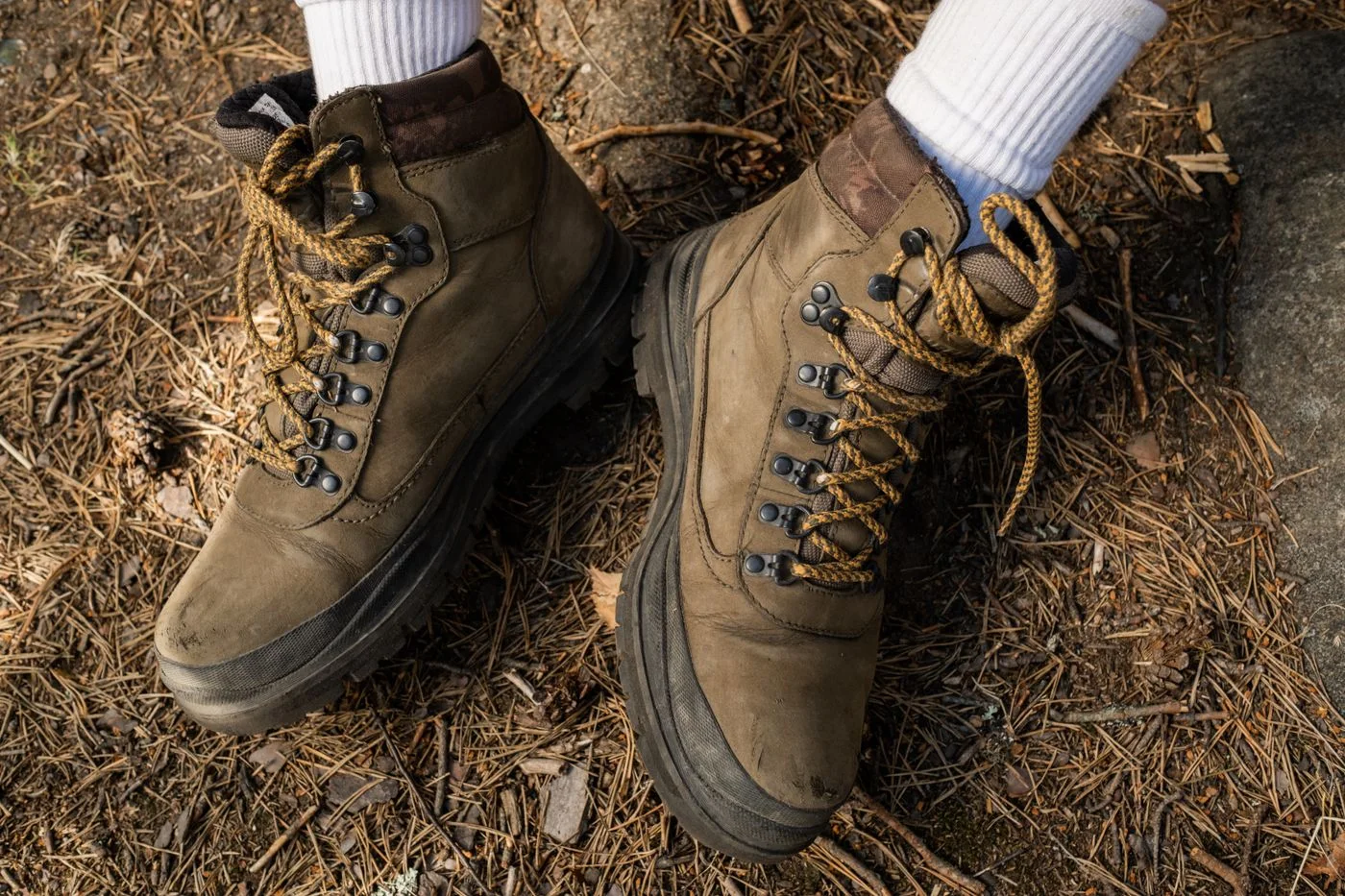
A hiking boot may feel comfortable with a thin everyday sock and suddenly feel crowded with the sock you intend to wear outdoors. Thick padding can also seem to fill a boot that is fundamentally too roomy. Bring your actual walking socks to the fitting rather than relying on whatever you happen to be wearing. LOWA specifically recommends trying boots with the socks intended for hiking. The sock belongs to the fit and should stay consistent during your first comparisons.
Start with a consistent setup
Put on both boots, smooth the socks and lace each boot evenly. A fold beneath your foot or a rolled sock cuff can change what you feel. If you already use replacement insoles, bring them and ask the shop whether they are appropriate for the boot. Do not casually stack several insoles: that changes where your foot sits inside the footwear.
Compare two sizes or models with the same socks first. Otherwise, it becomes difficult to tell whether a difference comes from the boot or the fabric around your foot. Once you have found a promising shape, trying another sock thickness can be useful. Treat that as a deliberate adjustment rather than a way to make every boot fit.
Stand, walk and change direction
Do more than sit down and move your toes. Walk for several minutes, pause and change direction. Notice whether your heel lifts noticeably with every step, whether the sides of the forefoot feel compressed, or whether you must pull the laces exceptionally tight to feel held. The size printed on the label cannot answer those questions.
If the shop has a suitable fitting ramp, walk up and down it carefully. On the downhill section, your toes should not hit the front. Walking uphill should not create a concentrated pinch. Use a purpose-made, secure test surface and ask the staff if you are unsure about it. A brief level walk between shelves does not reproduce all of those movements.
Then spend another moment standing still. Some problems become clearer after the initial attention to a new pair has faded. Assess both feet separately. A pair that works perfectly on the right but feels wrong on the left is not yet a settled choice.
A different size is not the only answer
Extra length does not automatically provide the right width. A larger boot might relieve pressure around the forefoot while allowing too much heel movement. A different last or model may be a better direction. Describe the location of pressure or movement to the fitter rather than asking only for the next size up.
Do not dismiss an obvious uncomfortable spot on the assumption that breaking the boot in will solve it. HANWAG advises choosing another model when a boot rubs during the shop fitting. Also distinguish the unfamiliar feel of firmer footwear from a definite pressure point. A new boot need not feel like an old favorite immediately, but its fit should make sense before you commit to it.
Repeat the check at home
After buying, check the retailer's returns conditions before taking the boots outdoors. A clean indoor fitting may still be possible under those conditions; a used outsole changes the situation. Repeat the check with your intended socks and enough time to consider both feet.
If the pair fits, start with a short walk that is easy to cut short. That outing lets you learn how the boot, sock and lacing work together. It does not prove that every longer or more difficult route will feel the same. Keep one specific observation for the next adjustment, such as a slightly looser upper lacing zone or a sock cuff that extends farther above the collar.